
Discover the structure of using and storing fire extinguishers
Discover the structure of fire extinguishers, working principles of fire extinguishers and how to use and maintain some common types of fire extinguishers.
Explore the structure of fire extinguishers, the working principles of fire extinguishers and how to use and preserve some common types of fire extinguishers. Fire extinguishers are an indispensable tool today, used for fire prevention and fighting. However, how to safely store fire extinguishers is a necessary issue.
>>> Please see more: Fire alarm system, some equipment such as automatic fire alarm system and addressable fire alarm system.
Common types of fire extinguishers today
- There are 2 types of cylinders used: powder cylinders and CO2 cylinders
- The simplest distinguishing feature of these two types of cylinders is that powder cylinders usually have a larger body than air cylinders and also have a pressure measuring needle, while air cylinders have a small body and do not have a measuring needle.
- Some points about the structure and working principle of this fire extinguisher.
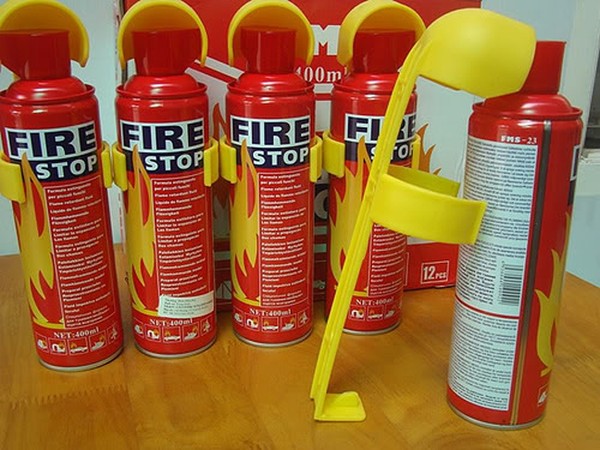
Portable powder bottle a. Structure and operating principle Powder fire extinguishers are of two types: Type with separate propellant tank, Type without separate propellant tank The type has its own propellant tank. The propellant tank can be placed inside - MF tank or outside the tank
-OPX powder tank The type does not have a separate propellant tank but feeds gas directly into the powder tank - the MFZ tank. Chinese dry powder fire extinguishers, symbol MFZ (BC) or MFZL (ABC), are highly mobile fire extinguishers, using N2 nitrogen gas loaded into the tank to push the powder out. The tank body is made of high-strength steel. The propellant tank is connected to the powder tank by a xifong tube. MFZ tank has a gas pressure gauge, MF tank does not have a pressure gauge. Propellant gases are usually Nitrogen, Carbonic, Carbon Hydrogen Halogen,...
The valve cluster is attached to the lid, which can be removed and refilled with powder and gas after use. The lock valve is either a squeeze valve or a screw valve and the lock valve is clamped with lead. Spray speakers are made of metal, plastic, rubber, size depends on type of bottle, length depends on type of bottle. The bottle is painted red and has technical specifications and usage instructions written on the body. Silicomized fire extinguishing powder (BC or ABC powder) and gas are sealed in the tank so it is difficult to get wet or clot, has a long storage time and is safe. Storage temperature from -10 degrees Celsius to 55 degrees Celsius. When the injection pressure drops to a relatively stable level, the effective fire suppression time is relatively long. b. Use a fire extinguisher Safe to use, reliable, simple to operate, easy to check, high fire fighting efficiency. With ABC type powder extinguishers used to extinguish most types of solid, liquid, and gas fires. With BC powder extinguishers, it can also extinguish most types of liquid and gas fires, but for solid fires the effectiveness is not high. Extinguish fires from electrical equipment with up to 380V power. Do not use powder extinguishers to extinguish fires in high-precision equipment or electronic circuits. Fire extinguishing powder is non-toxic, harmless to humans, livestock and the environment. The tank is suitable for fires involving petroleum and petroleum products.
+ For portable type: Move the tank closer to the fire location. Shake a few times if it is a powder tank with propellant gas mixed with powder (MFZ). Pull the lead clamp retaining pin. Standing in the wind direction, aim the spray speaker at the base of the fire. Keep the tank at a distance of 4 - 1.5 m depending on the type of tank. Squeeze the valve to spray fire extinguishing powder. When the gas is weak, move closer and spray multiple speakers back and forth to completely extinguish the fire.
+ For carts Push the cart to the fire, pull out the powder nozzle, and direct the powder nozzle at the base of the fire. Pull the safety latch (lead clip), pull the main valve on the tank mouth perpendicular to the ground. Hold the spray nozzle tightly, choose the direction of the wind and pull the trigger, the powder will be sprayed.
c. Store fire extinguishers. Place it in a visible, easy-to-reach place for convenient firefighting. Place in a dry, ventilated place, avoid places with strong sunlight and heat radiation, maximum temperature 50 degrees Celsius. If kept outside, there must be a roof. When moving, you need to be gentle. Avoid direct contact with high temperatures and vibrations. Must regularly check the tank according to the manufacturer's regulations or at least once a month. If the needle is below the green line, it must be refilled. After opening the valve, it is necessary to fully refill the fire extinguisher. Before loading, remove the sealed components, remove and clean the powder-contaminated parts. If there is still pressure, before removing it, you must reduce the pressure by slowly squeezing the valve to let the gas gradually escape. The pressure gauge needle points to the value O. When opening, you hear a ''hissing'' sound, immediately stop and check again. . Before each new gas fill and after 5 years of use, the tank shell must be hydraulically tested. Only after reaching the required strength can it be used, at least 30 MPa. Check the propellant through a manometer or scale and compare it with the original mass. Check the powder volume by comparing it with a scale. Check the nozzle and spray speaker e. Attention Read the instructions, carefully understand the functional features of each type of extinguisher to arrange fires accordingly.
When spraying, you must stand in the direction of the wind - the fire will burn outward; stand near the door - fire inside. When spraying, you must turn it off completely before stopping spraying. When extinguishing fires, liquid must be sprayed to cover the burning surface, avoid spraying directly onto the liquid to prevent it from splashing out and causing a bigger fire. When spraying, depending on each fire and the amount of propellant remaining in the tank, choose the appropriate spray position and distance. Used fire extinguishers should be kept separate to avoid confusion. When spraying, keep the can in an upright position.
Have 0 comment, evaluate about Discover the structure of using and storing fire extinguishers
TVAdministratorsAdministrators
Welcome, honored guests. Please leave a comment, we will respond soon